
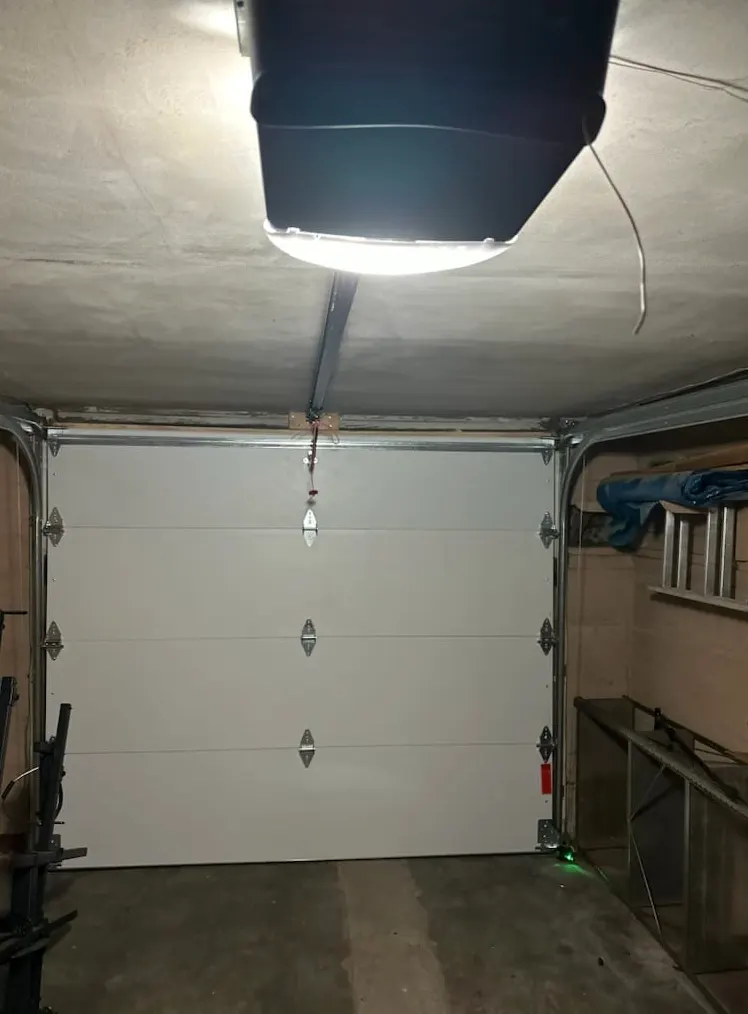
What a technician actually sees on these calls
The call usually comes in a day or two after a storm knocked the power out. One spouse is convinced the garage door opener should have kept working because "it's supposed to have a backup." The other swears they never paid for that. By the time a technician shows up, the car is stuck in the garage, the manual release cord has been yanked on (sometimes wrong), and nobody can agree on whether the opener was ever supposed to run without power in the first place. So let's settle it.
What battery backup actually is
A battery backup garage door opener has a rechargeable battery built into or attached to the opener head. When the power is on, the battery sits there charging. When the power cuts out — during a thunderstorm, a grid issue, or a hurricane-season outage — the opener automatically switches over to the battery and keeps working for a limited number of open/close cycles, usually somewhere in the range of 10 to 20 before it needs power again to recharge.
It is not a whole-house generator and it is not permanent. It's there to get you in or out a handful of times until the power comes back or you have another way to open the door.
What it is not
- It is not the same as the manual release. Every garage door opener, battery backup or not, has a manual release cord (usually red) that disconnects the trolley from the opener so you can lift the door by hand. That's the true no-power fallback, and it works whether or not you ever spent a dime on a battery.
- It is not automatic on older openers. If your opener is more than a few years old, there's a good chance it simply doesn't have this feature at all, and no amount of arguing will make it appear.
- It doesn't make the door storm-rated. Battery backup and wind-load reinforcement are two completely separate things. A door can have one, both, or neither.
Is it required?
This is where a lot of households genuinely disagree, because the honest answer is: it depends on the opener model and when it was installed, not on a blanket rule everyone follows. Some newer opener lines now ship with battery backup built in as a standard feature, simply because manufacturers have decided it's worth including. Others still sell it as an upgrade or an add-on module. There isn't one universal requirement that applies to every household — what matters is checking the specific opener you have (or the one you're shopping for) and reading what it includes.
What is true everywhere: if your opener predates this feature, it will not add itself. If you want it, it has to be installed, either as a new opener or as an add-on battery pack compatible with your existing unit.
Why this matters more here than in a lot of places
In Polk County, power outages tied to afternoon storms and hurricane-season systems aren't rare events — they're a seasonal pattern. A garage door opener that goes dead at the exact moment you need to pull a car out ahead of a storm, or get it under cover before one hits, is more than an inconvenience. Add in the humidity swings common to this area, which can make wood and some composite doors swell slightly and bind in the track, and a stuck door during an outage becomes a two-part problem: no power, and a door that's fighting you even with the manual release.
This is also why keeping the manual release mechanism in good working order matters as much as any battery. If the release arm is rusted, bent, or hard to reach, it won't matter whether you have a backup battery — you still won't get the door open smoothly by hand.
The real trade-off
Battery backup openers and retrofit battery packs cost more upfront than a standard opener, generally landing in a noticeably higher price bracket than entry-level models, since you're paying for the extra hardware and the smarts to manage charging and switchover. For a household that's often away when storms roll through, or that only has one way in or out of the house through the garage, that cost buys real peace of mind. For a household with an easy alternate entrance and a door that opens by hand without a fight, it's a nice-to-have rather than a necessity.
There's no wrong answer here — just a decision that depends on your specific door, your opener's age, and how much that few-minutes-of-power actually matters to your routine.
When to call Bartow Garage Door Repair
If you're not sure whether your current opener supports battery backup, or the manual release feels stiff, sticky, or hard to reach, that's worth a look before storm season catches you off guard again. We handle Garage Door Opener Installation for homeowners who want to upgrade to a battery-backup-capable unit, and we also do Garage Door Maintenance & Tune-Up visits that include checking the manual release, lubricating the track, and making sure everything moves the way it should when the power is out and patience is short.
If you're in Bartow, Lakeland, Winter Haven, Mulberry, Fort Meade, Eagle Lake, Lake Wales, or Auburndale and want a straight answer about what your opener can and can't do, give Bartow Garage Door Repair a call. We'll settle the argument for you.